

Brioche Couronne - Recipe from Scratch
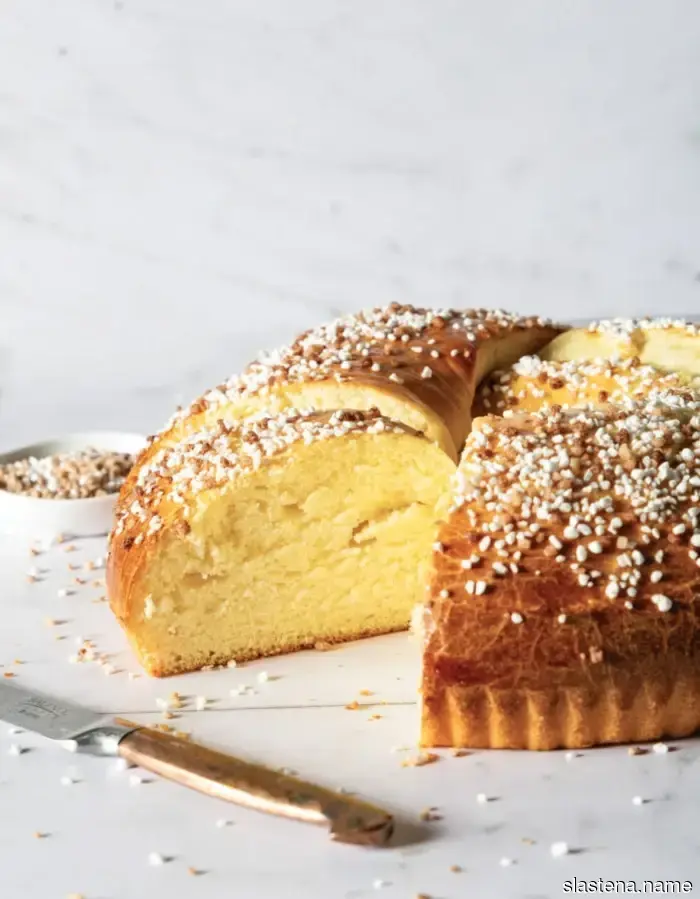
Enriched breads such as brioche originated in northern France in the 17th century, characterized by their significant amounts of butter and eggs—luxuries that represented both affluence and festivities. The dough is shaped into a couronne (French for "crown"), reminiscent of traditional breads made for celebrations. The slight addition of cornstarch reduces the overall protein content of the flour, which gently softens the crumb while maintaining its lift. This minor adjustment results in a texture akin to pastry brioche: light, fine, and nearly shreddable.
**Ingredients:**
- 2½ to 2¾ cups (313 to 344 grams) all-purpose flour, divided
- ¼ cup (50 grams) granulated sugar
- 2½ tablespoons (20 grams) cornstarch
- 2¼ teaspoons (7 grams) instant yeast
- 2 teaspoons (6 grams) kosher salt
- ¼ cup (60 grams) hot whole milk (120°F/49°C to 130°F/54°C)
- 4 large eggs (200 grams), divided, lightly beaten, at room temperature
- 3 large egg yolks (56 grams), lightly beaten, at room temperature
- ½ cup (113 grams) unsalted butter, cubed, at room temperature
- Garnish: Swedish pearl sugar, cinnamon pearl sugar
In the bowl of a stand mixer, combine 1½ cups (188 grams) flour, granulated sugar, cornstarch, yeast, and salt by hand. Add the hot milk; using the paddle attachment, mix at low speed until blended, about 1 minute. Incorporate 3 eggs (150 grams) and the egg yolks, mixing until combined, about 1 minute. With the mixer on low speed, gradually mix in 1 cup (125 grams) of flour, beating until a shaggy dough forms; scrape down the sides of the bowl.
Switch to the dough hook attachment. Beat at medium-low speed until the dough is smooth, elastic, and slightly tacky, about 4 to 6 minutes; add up to the remaining ¼ cup (31 grams) of flour, 1 tablespoon (8 grams) at a time, if the dough is too sticky. With the mixer on medium-low speed, gradually add the butter, 1 tablespoon (14 grams) at a time, mixing until incorporated after each addition (6 to 7 minutes total). Continue beating at medium speed until a smooth, elastic dough develops, approximately 10 to 12 minutes. Transfer the dough to a lightly floured surface; knead 5 to 8 times and shape into a smooth ball.
Lightly oil a large bowl. Place the dough in the bowl, turning it to coat the top with oil. Cover and refrigerate overnight. Lightly spray a 10-inch round fluted removable-bottom tart pan with baking spray that contains flour.
Turn out the dough onto a lightly floured surface and punch it down. Roll the dough into a log approximately 32 inches long, ensuring it is evenly thick throughout; taper the ends of the dough. Form the log into a circle, overlapping and pinching the tapered ends to make sure the circle has uniform thickness all around (the hole in the center of the dough circle should measure about 6¼ inches). Transfer the dough to the prepared pan. Cover and let it rise in a warm, draft-free area (75°F/24°C) until doubled in size, about 1½ hours.
Preheat the oven to 375°F (190°C). Lightly brush the remaining egg (50 grams) over the dough. Optionally, sprinkle with pearl sugars. Bake until golden brown and an instant-read thermometer inserted near the center reads 190°F (88°C), approximately 12 to 15 minutes, rotating the pan halfway through the baking time and covering it with foil during the last 5 minutes to prevent excessive browning. Allow the bread to cool in the pan for 10 minutes. Remove from the pan and let cool completely on a wire rack. Store in an airtight container for up to 3 days.
You can find our preferred Swedish pearl sugar here.
We’d love to hear how it turned out!
Other articles
Brioche Couronne - Recipe from Scratch
Breads such as brioche, rich with ingredients, appeared in northern France as early as the 17th century, characterized by a significant amount of butter and eggs—luxuries that represented affluence and festivity. The process of molding the dough into a couronne (the French term for “crown”) pays homage to traditional breads made for special occasions. A slight inclusion of cornstarch reduces the overall protein content.