
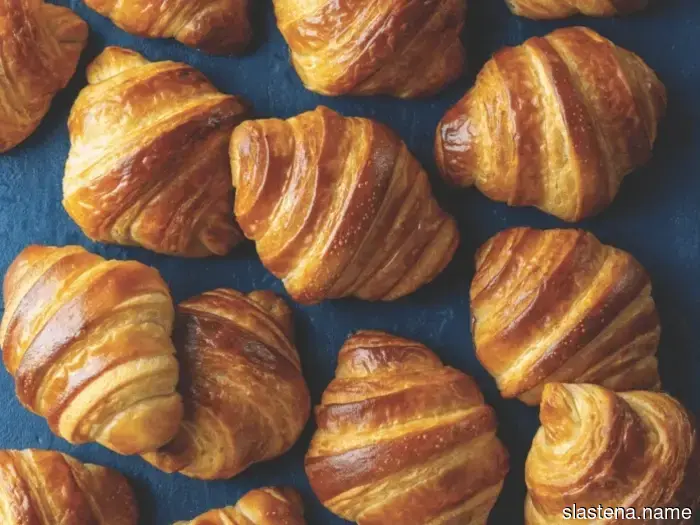
Croissants - Made from Scratch
Recipe by Nicole Plue
**Dough**
- ¾ cup plus 1 tablespoon (193 grams) cool tap water
- 4¼ teaspoons (13 grams) osmotolerant instant yeast
- 4 cups plus 2½ tablespoons (521 grams) all-purpose flour
- ¾ cup plus 1 teaspoon (185 grams) cold whole milk
- ¾ cup plus 1 teaspoon (98 grams) bread flour
- 5½ tablespoons (44 grams) whole wheat flour
- ⅓ cup plus 1 tablespoon (79 grams) granulated sugar
- 2 tablespoons plus 1 teaspoon (33 grams) unsalted butter* (European-style), softened
- 4 teaspoons (12 grams) kosher salt
**Butter Block**
- 1⅓ cups plus 2 tablespoons (330 grams) unsalted butter* (European-style)
**Egg Wash**
- 1 large egg (50 grams)
- 1 large egg yolk (20 grams)
- 1 teaspoon (4 grams) sugar
- ¼ teaspoon kosher salt
**Instructions for the Dough:**
In a stand mixer bowl, whisk the water and yeast together, allowing it to sit for at least 30 seconds. Incorporate the other dough ingredients and mix using the dough hook on low speed for 3 to 5 minutes, until the dough gains some strength. Move the dough to a container and cover it. Refrigerate overnight. The next day, prepare a butter block measuring approximately 8.5 inches by 8.5 inches; slight variations in size are acceptable. Note down your butter block dimensions.
On a lightly floured surface, roll out the dough to match one dimension of the butter block while doubling the other. Check if the butter block fits. Position the butter block in the center of the dough and fold the ends to meet in the middle, pressing the seam down and lightly rocking the pin along the length of the dough to combine them. Rotate the dough 90 degrees and roll it out, completing a double turn, trimming the edges if needed. Cover and let it rest in the refrigerator for at least 45 minutes.
After resting for 45 minutes, take the dough from the fridge, rotate it 90 degrees, and roll it out to perform a single turn, trimming the edges if necessary. Cover the dough and refrigerate it for a minimum of 2 hours.
For the final sheeting, remove the dough from the refrigerator and let it sit at room temperature (ideally around 68°F) for about 30 minutes.
For classic croissants, roll the dough out to a size of 9.5 inches by 23 inches. It may require a few attempts to extend the dough. If it shrinks, allow it to rest for 5 minutes. Trim the dough to 8.5 inches (21cm) by 21 inches (54cm). Mark every 8cm along the top long side. For the bottom long side, measure and mark 4cm over, then mark every 8cm. Starting from the top, cut triangles out of the dough connecting the top and bottom marks. Remove any excess flour from the surface. Hold the wide end of the triangle and gently stretch from the center towards the tip, taking care not to tear the dough. Clean off any excess flour from both sides of the triangle. With the tip facing away from you, slightly roll the top edge of the triangle outwards. Then gently roll up the triangle, preserving its center (be careful not to roll too tightly). Tuck the tip underneath before placing on the baking pan.
**Proofing and Baking**
*Oven Method:* Allow the pastries to come to room temperature. Mist with a light spray of water to prevent a skin from forming. Position the tray of pastries in a cold oven with an empty tray below it. Pour boiling water into the lower tray and close the oven door. The ideal temperature should be between 78°F and 80°F with 75% to 80% humidity. Using a digital thermometer/barometer can help in monitoring the temperature. When it drops, replace the water with more boiling water. It might take up to 5 hours for the croissants to proof.
*Ambient Overnight Proof:* Before sleeping, take the pastries out of the fridge and lightly spray with water. Cover the trays with a large plastic bin or wrap in plastic, ensuring the plastic does not touch the pastries to prevent them from drying out. Let them sit for 10 to 12 hours depending on room temperature. In both methods, the croissants are ready to bake when they have approximately doubled in size and look puffy, with visibly separated layers at the cut edges. Lightly shake the tray; the pastries should wobble easily.
Preheat the oven to 400°F convection (425°F conventional). Gently egg wash the croissants. Bake for 5 minutes
Other articles
 The Emergence of Small State Provisions - Bake from Scratch
Starting from a home kitchen and growing into a successful bakery, Kevin Masse's Small State Provisions in Hartford, Connecticut, represents the essence of baking with passion.
The Emergence of Small State Provisions - Bake from Scratch
Starting from a home kitchen and growing into a successful bakery, Kevin Masse's Small State Provisions in Hartford, Connecticut, represents the essence of baking with passion.
 Roasted Strawberry and Ricotta Cake - A Recipe from Bake from Scratch
This Roasted Strawberry and Ricotta Cake is a multi-layered dessert that fuses the creamy richness of BelGioioso® Ricotta con Latte® Cheese with the sweet depth of strawberries roasted in the oven. Finished with whipped mascarpone and fresh berries, it’s a vibrant and tasty delight ideal for spring and summer events. Roasted Strawberry and Ricotta Cake Yields 1 (9x5-inch) cake.
Roasted Strawberry and Ricotta Cake - A Recipe from Bake from Scratch
This Roasted Strawberry and Ricotta Cake is a multi-layered dessert that fuses the creamy richness of BelGioioso® Ricotta con Latte® Cheese with the sweet depth of strawberries roasted in the oven. Finished with whipped mascarpone and fresh berries, it’s a vibrant and tasty delight ideal for spring and summer events. Roasted Strawberry and Ricotta Cake Yields 1 (9x5-inch) cake.
 Fig Bars - Bake From Scratch
Fig Newtons have been a staple in lunch boxes and snack bags since their mass production began over 130 years ago. Our homemade rendition consists of a rich, buttery dough encasing a thick filling made from Mission figs, which are sweeter and softer than other types of figs, along with fresh orange zest and juice for a refreshing touch.
Fig Bars - Bake From Scratch
Fig Newtons have been a staple in lunch boxes and snack bags since their mass production began over 130 years ago. Our homemade rendition consists of a rich, buttery dough encasing a thick filling made from Mission figs, which are sweeter and softer than other types of figs, along with fresh orange zest and juice for a refreshing touch.
 Shop the Issue: July/August 2025 - Baking from Scratch
Cookbook Corner ISLAS: A TRIBUTE TO TROPICAL CUISINE FOR LAHAINA, WITH AFFECTION BREAKING BAO QUICK BAKING These quick recipes are simple, fulfilling, and can be prepared, combined, and baked in two hours or fewer.
Shop the Issue: July/August 2025 - Baking from Scratch
Cookbook Corner ISLAS: A TRIBUTE TO TROPICAL CUISINE FOR LAHAINA, WITH AFFECTION BREAKING BAO QUICK BAKING These quick recipes are simple, fulfilling, and can be prepared, combined, and baked in two hours or fewer.
 The Essentials: Hand Pies - Bake from Scratch
 The Emergence of Small State Provisions - Bake from Scratch
From a home kitchen to a successful bakery, Kevin Masse’s Small State Provisions in Hartford, Connecticut, represents the essence of baking with passion.
The Emergence of Small State Provisions - Bake from Scratch
From a home kitchen to a successful bakery, Kevin Masse’s Small State Provisions in Hartford, Connecticut, represents the essence of baking with passion.
Croissants - Made from Scratch
Recette de croissants par Nicole Plue Pâte ¾ tasse plus 1 cuillère à soupe (193 grammes) d'eau du robinet fraîche 4¼ cuillères à café (13 grammes) de levure instantanée osmotolérante 4 tasses plus 2½ cuillères à soupe (521 grammes) de farine tout usage ¾ tasse plus 1 cuillère à café (185 grammes) de lait entier froid ¾ tasse plus 1 cuillère à café (98 grammes) de farine à pain 5½ cuillères à soupe (44 grammes) de farine de blé complet ⅓ tasse plus